Thursday, December 3, 2009

1949- James Wong Howe marries Sanora Babb

James Wong Howe, relative of Anna May Wong, was born in Taishan Guangdong, China in 1899. His father emigrated to America when Howe was born to work on the Northern Pacific Railway and 5 years later sent for his family to live with him in Washington. Howe’s interest in photography began at an early age, and grew exponentially after his several oddjobs in Los Angeles, being a photographer’s delivery boy and taking stills during film productions under director Cecil B. DeMille. Howe developed a new method of photography as he captured a darker look in the eyes of Mary Miles Minter as she was producing a film with DeMille. Minter adored the photograph, so she made Howe her preferred photographer. Howe then established a reputation for himself as he was able to make female actresses look their best without having to cover them with any filters or stuff like that. He eventually built his way up and became a popular cinematographer and developed new methods of cinematography as well (ie: handheld camera, the camera dolly, lighting techniques, deep focus, and many more.) He then married (Caucasian) novelist Sanora Babb in Paris in 1947. It was not legally recognized because of the anti-miscegenation laws and interracial marriage bans at the time in the US. Their marriage was legally approved in 1949, after all such laws (such as the ban on interracial marriage) were realized to be unconstitutional. The Hays Code, the banning of a non-Caucasian to kiss a Caucasian on screen, however, lagged behind in being abandoned much later in 1968.


Sanora Babb 1938


The marriage of these two accomplished individuals was met with much scrutiny. The judge who married them just said, “She looks old enough to marry, if she wants to marry a chink that’s her problem.” It took them three weeks after inter-racial marriage was made legal to find a judge that would marry them, but even the one they found was disheartening. Considering the fact that the law banning people of different faces to join in marriage was in effect for so long, starting from the time when Asians and other immigrants established themselves as minorities in America, there was probably opposition coming from both parties, Asian Americans and White Americans alike. The law was in place for so long that no one in the country would be fully accepting of a marriage between two people of different races. James Wong Howe and Sanora Babb, however, defied these discouraging odds and wed anyway. This wedding in particular was significant to the lives of other Asian Americans in the nation because both of them were quite popular, so everyone had to find out about such a marriage. Having this inter-racial marriage be displayed for the country to see creates the sense that Asian Americans, (and non-Asian Americans) can marry whomever they wish to marry. The people of America started the process of acknowledgement in accepting the fact that people of different races are not so different after all, and that a miscegenated love (and that which follows) does not pose a threat to the American nation.

Go For Broke! (1951 Film)


In 1951 the movie Go For Broke! (directed by Robert Pirosh, produced by Dore Schary and stared Van Johnson, Robert Nakamura and several veterans of the 442nd Infrantry Regiment) was released to the American audience. The film is a dramatization of the real-life story of the 442nd infantry unit which was a unit that predominantly consisted of Nisei, second generation Japanese Americans, who were fighting primarily in the European theatre of World War II.

The film focuses on the experience of Van Johnson’s character, Lieutenant Michael Grayson, who has recently been assigned to the 442nd when he was expecting to the 36th Infantry Division of the Texas National Guard. Initially, Johnson is angered by the fact that he is leading a battalion full of Nisei soldiers because of his narrow mindedness about the war in which he joined to fight Japanese soldiers, not to fight with them, and in effect he led his battalion with very harsh and strict adherence to regulations. Eventually, Grayson discovers the meaning behind the battalion’s catch phrase, “Go For Broke!” which is a pidgin phrase that means to gamble everything. In the end, Johnson’s character gains respect for the Nisei soldiers that he is fighting alongside because of their attitudes and their willingness to fight for their country and they eventually discover that he has defended them against bigotry by members of his former infantry unit.

The unit itself is one of the most decorated units for its size and the length at which the regiment was in service in the United States Army. However, it also holds the distinction as one of the units with the highest rate of casualties. Below is a list of distinctions that was awarded to the unit:

· 21 Medals of Honor (the first awarded posthumously to Private First Class Sadao Munemori, Company A, 100th Battalion, for action near Seravezza, Italy, on April 5, 1945; the others upgraded from other awards in June 2000).

· 52 Distinguished Service Crosses (including 19 Distinguished Service Crosses which were upgraded to Medals of Honor in June 2000)

· 1 Distinguished Service Medal

· 560 Silver Stars (plus 28 Oak Leaf Clusters for a second award)

· 22 Legion of Merit Medals

· 15 Soldier’s Medals

· 4,000 Bronze Stars (plus 1,200 Oak Leaf Clusters for a second award; one Bronze Star was upgraded to a Medal of Honor in June 2000. One Bronze Star was upgraded to a Silver Star in September 2009.)

· 9,486 Purple Hearts

The importances of the unit as well as the film revolves around the question of how does one determine who is American and who is not? Is it based on skin color or is it based on the heart behind each person? The unit goes to show that just because a group of people don’t quite look like they’re Americans that doesn’t make them any less American nor do they represent a less patriotic American.


Thai Nguyen

1944 - CHINESE AMERICAN SOLDIERS IN WORLD WAR II


Chinese Americans, like all other Americans, bravely served to preserve the American way of life and to advance democratic ideals around the world during WWII. Of the six million Americans who were drafted or enlisted to serve in the Second World War, over 20,000 Chinese Americans served in the Army, Navy, Air Force, the Marines, and the Coast Guard. These brave men and women served with honor in the European, Pacific, and the China-Burma-India Theatres of Operation. While most of these men and women are descendants of earlier Chinese immigrants, some were also first generation immigrants. It has been documented that these servicemen and women brought valuable skills and served the United States in a number of different capacities, as fighter pilots, intelligence operatives (Europe & Asia), infantrymen, nurses, and others throughout WWII. These great Asian Pacific American soldiers were honored by Congress on October 26, 1999.

First time in history, Chinese American women were recruited to serve with the Army Air Force as "Air WACs during WWII. They were often called the Madame Chiang Kai-Shek Air WAC unit. Hazel Toy Nakashima and Jit Wong were the first two women to become "Air WACs." They served in such jobs as photo interpretation, air traffic control and weather forecasting.

Other important Asian American women during WWII, were Chinese American Hazel Ying Lee and Maggie Gee. Hazel was one of 38 Women Airforce Service Pilots, or WASPs, who died in the line of duty. Maggie Gee, took male military pilots up for qualifying flights to renew their instrument ratings and co-piloted B-17 Flying Fortress bombers through mock dogfights staged to train bomber gunners.

Many Japanese women served in the armed forces while their families were in internment camps. Many Japanese and Chinese women were trained as interpreters and translators, and some Filipino American women put their lives on the line as members of the underground resistance in the Philippines.


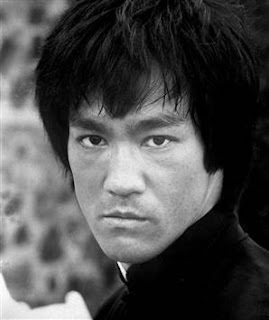
Bruce Lee (1940-1973): Actor, Martial Arts Expert, and Anti-Racist

Biography of Bruce Lee

Bruce Lee (Lee Hsiao Lung) was born in San Francisco in November 1940 the son of a famous Chinese opera singer. Bruce moved to Hong Kong when he soon became a child star in the growing Eastern film industry. His first film was called The birth of Mankind, his last film which was uncompleted at the time of his death in 1973 was called Game of Death. Bruce was a loner and was constantly getting himself into fights, with this in mind he looked towards Kung Fu as a way of disciplining himself.

At the age of 19 Bruce left Hong Kong to study for a degree in philosophy at the University of Washington in America. It was at this time that he took on a waiter's job and also began to teach some of his skills to students who would pay. Some of the Japanese schools in the Seattle area tried to force Bruce out, and there were many confrontations and duels fought for Bruce to remain.

He met his wife Linda at the University he was studying. His Martial Arts school flourished and he soon graduated. He gained some small roles in Hollywood films - Marlowe- etc, and some major stars were begging to be students of the Little Dragon. James Coburn, Steve McQueen and Lee Marvin to name but a few. He regularly gave displays at exhibitions, and it was during one of these exhibitions that he was spotted by a producer and signed up to do The Green Hornet series. The series was quite successful in the States - but was a huge hit in Hong Kong. Bruce visited Hong Kong in 1968 and he was overwhelmed by the attention he received from the people he had left.

He once said on a radio program if the price was right he would do a movie for the Chinese audiences. He returned to the States and completed some episodes of Longstreet. He began writing his book on Jeet Kune Do at roughly the same time.

Back in Hong Kong producers were desperate to sign Bruce for a Martial Arts film, and it was Raymond Chow the head of Golden Harvest who produced The Big Boss.

On the 10th May 1973, the trouble for Bruce Lee had begun. While dubbing the sound effects for "Enter the Dragon", he passed out for a whole half an hour. He went to the hospital, and was prescribed the drug Manatol. It was used to reduce an apparent brain swelling.

On July 20th 1973, Bruce had arranged to meet Raymond Chow along with actress Betty Ting Pei who would star in "Game of Death". He stopped off at Betty`s house and told her that he had a headache. She gave him an Aquagesic (a painkiller that she regularly used ). Bruce laid down in her bed and went to sleep. During his sleep, the brain swelling returned and triggered an allergy to the painkiller called a cerebral edema.Later Betty tried to wake him but couldn't. Panicking, she called Raymond Chow, who came over and called the doctor. Bruce was rushed to the Queen Elizabeth hospital, barely alive. The ambulance crew was fighting to resuscitate him, but Bruce was pronounced "dead on arrival".

As the news spread across the world, people talked about nothing else, refusing to believe it. Bruce had two funerals, one in Hong Kong and one in the U.S. Over 27,000 people attended his funeral, few could hide their grief. People were just breaking down and crying when they saw him in the open coffin. A banner was placed amongst the many tributes reading "A star sinks in a Sea of Art".

When the press found out that Bruce had died at Betty`s house, they were quick to speculate that Bruce had died while they were having sex. To this day vicious rumours are still spread across the world. At the airport, Linda broke her silence and told Hong Kong to drop it and that she blamed nobody, and that Bruce had died of natural causes. His funeral in Seattle was attended by all his friends, family and former students. James Coburn and Steve McQueen acted as pallbearers. Should you wish to watch the funeral, you can find it on the documentary (Bruce Lee: The Man and the Legend). Finally on July 31st, 1973, Bruce was laid to rest in Seattle at the Lake View Cemetary. His and Brandon's graves are regularly visited by people from all over the world. There are ALWAYS fresh flowers on their graves each day. Some day, I too will place mine there and pay my respect to my favourite person in the whole world.

Films of Bruce Lee

(猛龍過江: The Way Of The Dragon, 1972)
(唐山大兄: The Big Boss, 1971)
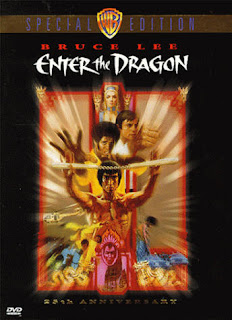
(龍爭虎鬪: Enter The Dragon, 1973)
(死亡遊戱: The Game Of Death, 1978)
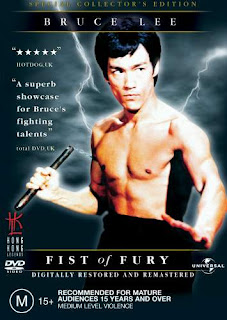
(精武門: Fist Of Fury, 1972)
Racism and Bruce Lee

Few people know of Lee’s tumultuous struggle to overcome racism and bridge the gap between White and Asian Americans.

When asked about “racial barriers,” he told a Hong Kong journalist in 1972 that “I, Bruce Lee, am a man who never follows those fearful formulas. . . . So, no matter if your color is black or white, red or blue, I can still make friends with you without any barrier.”

Lee became one of the first martial arts sifus (masters) to train non-Asians, whites (like Chuck Norris and Roman Polanski) and blacks (like Kareem Abdul-Jabbar), and all manner of Asians.

Lee’s success in the United States, then, cannot be credited only to the 1960s emergence of Hong Kong, but it must crucially be seen in light of the changed place of Asians in the United States as a result of U.S. immigration policy, the limited gains of the Asian American movement, and, due to the latter, the cheerless acceptance of multiculturalism.

Wednesday, December 2, 2009

Young Oak Kim: Korean-American Hero of World War II, Korean War

As a Korean-American officer in the 100th Battalion, Young Oak Kim might have seemed out of place. Most of his fellow officers were White, and virtually all of the men he commanded were Japanese-Americans.

But Kim did not see it that way. He saw himself as an American serving alongside other Americans. And he fit in so well and performed so gallantly that he became the most decorated Asian-American soldier in history.

Joining the 100th Battalion

Kim, who was born and raised in Los Angeles, joined the Army in 1941 and started out as an engineer. He was selected to Officer Candidate School at Fort Benning, Ga., and shortly after graduating, was assigned to the 100th Battalion.

Almost immediately after joining the unit in January of 1943, Kim was offered the opportunity to transfer. Korea was under brutal occupation by the Japanese, and Kim's superiors feared he would not mix well in a battalion consisting almost entirely of Japanese-Americans. His assignment had apparently been a mistake.


But the 24-year-old lieutenant insisted on staying, telling Lt. Col. Farrant Turner, the battalion commander, that the soldiers of the 100th were all Americans fighting for a common cause.

Initially a platoon leader, Kim gained a promotion to captain as a well as a positions as battalion operations officer and intelligence officer. He also gained the respect of his men during combat in Italy.

Kim's Daring Mission

Kim would win 19 medals during his military service, including the Distinguished Service Cross. He received his nation's second-highest decoration for a daring volunteer mission on the night of May 16. 1944, in Italy. Kim and five other men crawled into enemy positions to capture a pair of German soldiers. The prisoners gave up information that proved vital to the Allied breakout from the Anzio beachhead.

Earlier, Kim had been awarded a Silver Star for leading an attack that bagged 58 prisoners near Cassino, Italy.

After seeing action in further battles in Italy and France, Kim suffered a serious wound in the hand during a fight for the French town of Biffontaine in October of 1944. While being evacuated, Kim narrowly escaped when his litter train was captured by Germans. He was on leave when the war in Europe ended.

Heroism in Korea


Kim left the army after World War II, but went back into service during the Korean War in 1950, winning a second Silver Star. He led South Korean guerilla groups, served as both an intelligence and operations officer and earned a promotion to major. Ironically, he had never set foot in the nation of his ancestry before the war.

Despite being wounded in a friendly fire incident, Kim went on to lead a battalion of the 31st Infantry Regiment of the Seventh Infantry Division, becoming the first ethnic minority to command a regular U.S. Army combat battalion. His unit helped turned the tide of the war and push Communist troops back across the 38th parallel.

Kim remained in the Army until 1972, retiring as a colonel.


Kim the Community Leader

After serving in the Army for 30 years, he retired in 1972. He then actively participated in Asian American community affairs. He helped found the Go For Broke Monument, Go For Broke Educational Foundation, the Japanese American National Museum, the Korean Health, Education, Information and Research Center, the Korean American Coalition, the Korean American Museum, the Korean Youth and Cultural Center, and the Center for Pacific Asian Families.

Kim, who was active in helping war orphans in Korea, continued his charity work after leaving the military. He served with the United Way and several other non-profit organizations, and was a co-founder of the Go For Broke Educational Foundation, a group that educates teachers and student about Japanese-American veterans.


His volunteer work was instrumental in the building of the Go For Broke Monument in Los Angeles. A stone structure dedicated in 1999, the monument honors members of the 100th/442nd as well as Japanese-Americans who served in military intelligence in the Pacific Theatre during World War II.

Kim died of cancer in 2006. A middle school in Los Angeles was renamed Young Oak Kim Academy in his honor in July of 2009.


A middle school named for a Korean-American war hero will be set up in California this year. The Los Angeles Unified School District announced on Tuesday that Young Oak Kim Academy will open in the Koreatown area of the city in September. The late Colonel Kim Young-oak was a highly decorated member of the U.S. Army’s 100th Infantry Battalion/442nd Regimental Combat Team who served in World War II and the Korean War.

Born in Los Angeles, Colonel Kim was a second-generation Korean-American widely remembered for his wartime heroics. He was awarded medals from France, Italy, Korea and the U.S. for courageous and exemplary achievements. Following his discharge from the Army, Kim devoted the rest of his life to charity work, helping war orphans and young people. Dying at the age of 86 in 2006, he is one of the most admired figures in the history of Korean immigration to the U.S.

Young Oak Kim Academy is L.A.’s first middle school and third school overall named for a Korean, after Charles H. Kim Elementary and Mariposa-Nabi Primary Center. Its establishment is due in great part to the efforts of the Friends of Colonel Young Oak Kim, an organization founded in 2006 by a group seeking to commemorate the colonel’s exemplary spirit. After organizing campaigns and sending numerous petitions to the local community and politicians, the organization’s efforts have finally borne fruit.

Kim as Author


Issued by the 100th/442nd/MIS WWII Foundation commemorating the service and sacrifices of the Japanese American soldiers at the unveiling of the Go For Broke Monument in Los Angeles on June 5, 1999.

1943 - Madame Chiang Kai-shek - Chinese Exclusion Act


[ Refer to the picture ] Madame Chiang Kai-shek, the wife of China's leader, delivers an address at Los Angeles' Hollywood Bowl. During the East Coast leg of her American tour, the American educated Chinese First Lady asks Congress to repeal Chinese Exclusion laws. Her wish is granted.

Soong May-ling also known as Madame Chiang Kai-shek was born on March 5, 1897 and was the First Lady of the Republic of China, the wife of former President Chiang Kai-shek. She was a politician and painter. The youngest and the last surviving of the three Soong sisters, she played a prominent role in the politics of the Republic of China.

Born in China and educated in the United States, Soong Mei-ling married Chiang Kai-shek in 1927 and went on to become an internationally famous advocate for her husband's Chinese Nationalist government. Fluent in English and a student of Chinese culture, she was a goodwill ambassador and the popular partner of Generalissimo Chiang during the 1930s. During World War II she went on an international tour and spoke before the United States congress (1943) to drum up support for China's fight against Japan. Articulate and charismatic, her celebrity status was considered a key element in winning funds and weapons from the Allies (including airplanes - Madame Chiang was key player in the Chinese air force).


The Chinese Exclusion Act was a law passed by the U.S. Congress in 1882 in response to nativist hatred of Chinese immigrants. It prevented the large scale immigration of Chinese workers into the U.S. although tens of thousands came in illegally. Restriction was repealed in 1943 and amnesty was provided for the thousands of illegal Chinese immigrants in the 1950s.

The laws were repealed in 1943, during World War II, as the U.S. and China were allies fighting the Japanese. President Franklin D. Roosevelt believed that making China an "equal" ally in every way would be important to preserve postwar stability. Public opinion in favor of the Chinese was mobilized by the nationwide speaking tours of Madame Chiang Kai-shek, the American educated wife of the Chinese leader, and by publicity in Time and Life magazines.


In the United States, she drew crowds as large as 30,000 people and made the cover of TIME magazine (she had first appeared in 1937 with her husband as "Man and Wife of the Year)" On February 18, 1943, she became the first Chinese national and second woman to address both houses of the U.S. Congress


As a fluent English speaker, as a Christian, as a model of what many Americans hoped China to become, Madame Chiang struck a chord with American audiences as she traveled across the country, starting in 1930s, raising money and lobbying for support of her husband's government. She seemed to many Americans to be the very symbol of the modern, educated, pro-American China they yearned to see emerge, even as many Chinese dismissed her as a corrupt, power-hungry symbol of the past they wanted to escape.

1942 Frank Fong - ONE OF THE FIRST CHINESE AMERICAN FIGHTER PILOTS


Frank Fong, a natural born American citizen, volunteered in World War II to join the Army and was denied the right to join the Army, because of his race. He was unsuccessful getting local help to join up, and had to write General Hap Arnold for assistance. After reviewing Fong’s application, the General appointed Fong as a pilot candidate.

Due to a pilot shortage, Frank Fong was assigned to non-combat flying status and flew reconnaissance missions in support of the D-Day Normandy invasion. In a follow-up flying assignment, Lt Col Fong commanded the Fifth Emergency Rescue Squadron which rescued many US and Allied aircrews downed in the North Sea. In 2001 the English military honored Colonel Fong and his squadron for their heroic rescue missions during WW II. He was recalled to active duty during the Korean War and also the Vietnam War.

Fong suffered racial discrimination and was denied entry when he voluntarily applied to the United States Army Air Force (USAAF). With determination and persistence, he was finally accepted by the USAAF. This opened the door for other Chinese Americans later to serve in the United States military services.

It took 48 years for the U.S. Department of Veterans Affairs to concede that a plane crash scarred his left eye and eventually took his sight. It took two more years for the VA to agree that Fong is seriously disabled by nightmares and flashbacks of violent air combat missions. And nearly three years to fully compensate him for his blind eye and for a back injury from the plane crash, VA records show.

Fong's battle with the VA isn't over. He's still seeking back pay for the years 1950-1997, when the VA refused to acknowledge his blindness. This 54-year ordeal illustrates how technicalities in the VA's disability compensation system shortchange those who lack well-trained advocates and the persistence to keep fighting for years.


Lt. Colonel Fong's contributions have made life better not only for Asian Americans in Miami-Dade County but all Americans in the United States and all people in the world.In November 2000, Lt. Colonel Fong was among eleven other Chinese American WWIIveterans who were honored and recognized by Miami-Dade County Mayor Penelas during the premiere screening of the documentary film, We Served with Pride: The Chinese American Experience in WWII. The screening was organized by the Organization of Chinese
Americans - South Florida Chapter.

Fong went on to serve in the U.S. Air Force in the Korean War and the Vietnam War. Over his illustrious career, Fong received two Distinguished Flying Crosses, eight Air Medals, a Purple Heart, a European Theater Ribbon with four Bronze Stars, American Theater Ribbon of Merit, Korean Medal, Intelligence Medallion, Senior Pilot Wing, Expert Medal and many other honors..